Gecko adhesive hairs gets stickier the faster they slide

Even geckos encounter perturbations and environments that can challenge their ability to stick. The hairs of a gecko’s foot are composed of dry, hard keratin. Classic physics predicts dry, hard solids to have frictional forces that decrease at the onset of sliding (kinetic friction is less than static friction). We discovered that gecko adhesives actually […]

Continue reading Gecko adhesive hairs gets stickier the faster they slide

Bio-inspiration from how cockroaches navigate by touch

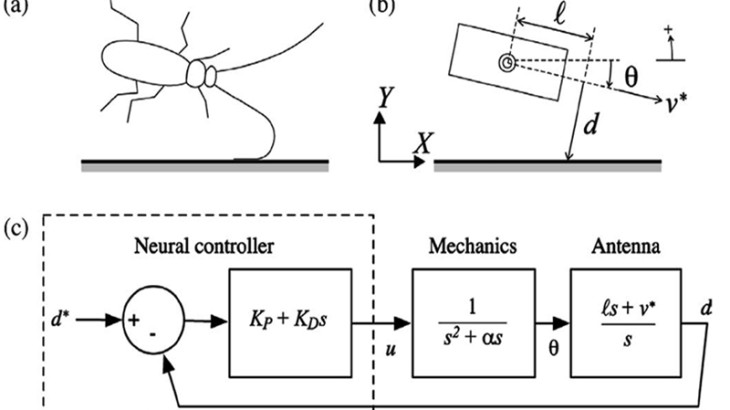
Animals must sense their environment in order to navigate. American cockroaches (Periplaneta americana L.) in the natural world often face navigation challenges in cluttered, low-light environments. To supplement their vision, they use their antenna as tactile probes. They can track surfaces with their long antennae by letting the antenna bend against the surface and rapidly […]

Continue reading Bio-inspiration from how cockroaches navigate by touch


How roaches run on rough terrian.

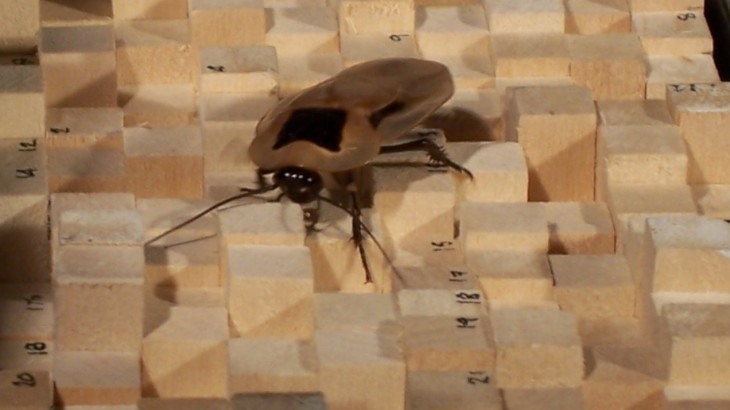
We tested whether mechanical stabilization strategies without external sensing can yield successful locomotion in a challenging environment. In this study, we ran cockroaches (Blaberus discoidalis) over a highly complex terrain with obstacles up to three times cockroach hip height to repeatedly perturb body dynamics. Cockroaches provide excellent systems for neuromechanical experiments because they are experimentally robust and […]

Continue reading How roaches run on rough terrian.